Verified Dubai Escort Services: Safe, Discreet Booking Guide
When people in the UAE begin researching escort services, the first thing they notice is how unevenly the market presents itself. In Dubai, Abu Dhabi and Sharjah alike, listings promise verified profiles, discreet arrangements and transparent rates, yet a buyer rarely has a practical way to confirm any of it. The gap between what a listing claims and what can be independently checked is wide, and this article, which builds on the wider analysis of the same subject, focuses on how to close that gap in a disciplined way. Whether you are a visitor in Dubai for a trade event or a resident in Abu Dhabi, the sequence of checks described here is designed to reduce avoidable risk, not to endorse any provider. Readers who want to see how one platform structures its listings can visit website and then compare what it displays against the criteria below.
Before any practical step, the legal baseline must be stated plainly. Commercial sexual activity is a criminal matter under UAE federal law, and the rules do not soften at emirate borders. A Dubai hotel, an Abu Dhabi residence and a Sharjah office all fall under the same federal provisions, which means that a booking decision made in any of these cities carries the same legal weight. Everything that follows assumes that legal exposure is the foundation of the decision, not a footnote to it.
None of these steps eliminates risk entirely, and no listing, including those presented on a platform, can guarantee the conduct or accuracy of every provider
Why the Dubai, Abu Dhabi and Sharjah Market Is Hard to Read
The listing ecosystem across the three emirates is fragmented. Advertisements appear on messaging channels, informal directories and a handful of websites, and each uses different conventions for photographs, descriptions and pricing. A profile that appears in Dubai may reappear in Sharjah with altered details, and the same contact number can be attached to several names. For a buyer, this fragmentation means that no single source is authoritative, and the first task is recognising that the information in front of you is a set of claims rather than a verified record.
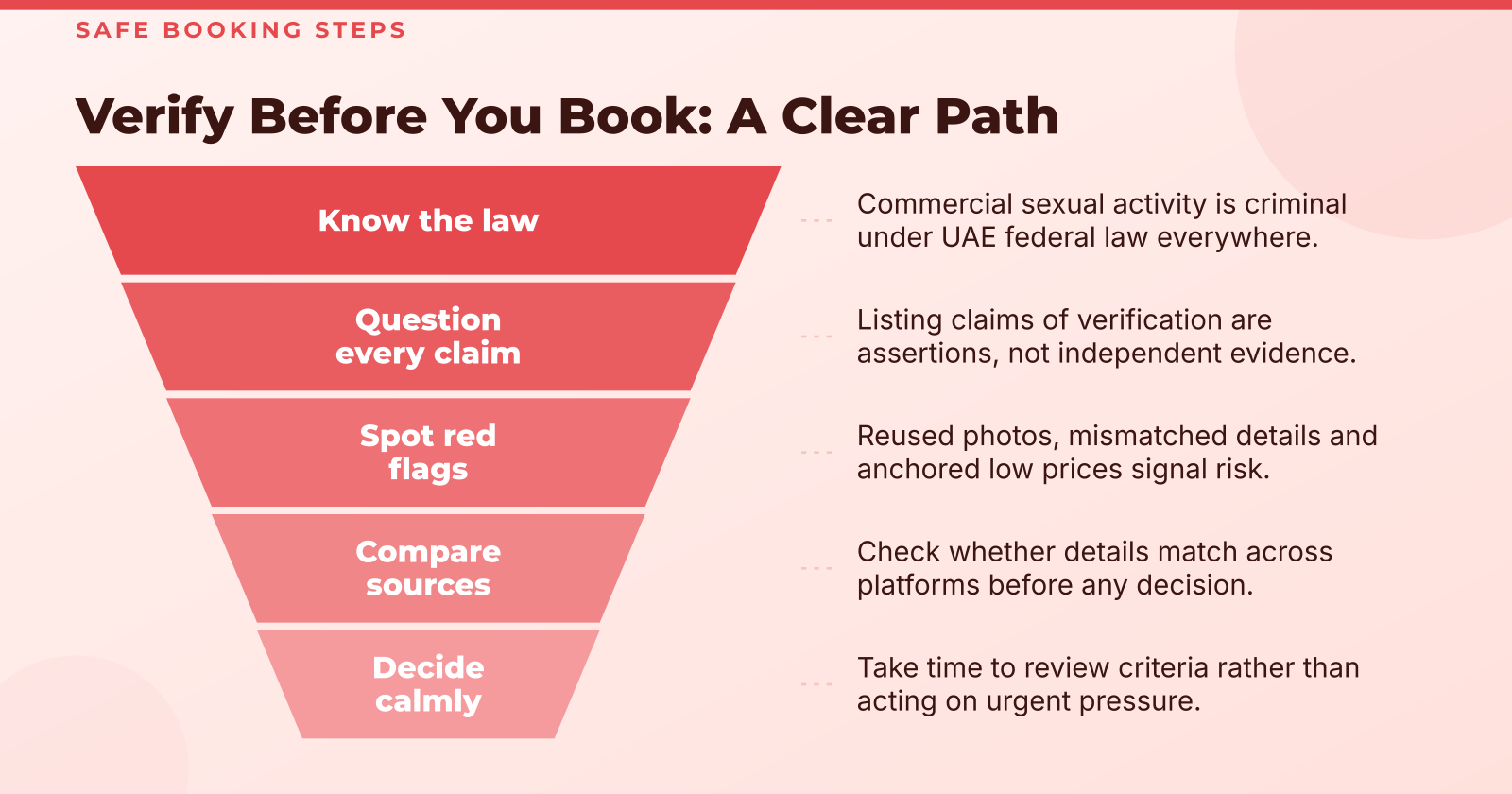
Listings typically rely on three signals: photographs, short written descriptions and rate cards quoted in AED. Each of these signals can be produced without any independent check. A photograph can be lifted from another account, a description can be copied across dozens of profiles, and a rate can be stated without specifying what it covers. The practical consequence is that a self-reported claim of verification is simply the provider's assertion. It is useful as a starting point for questions, but it cannot stand in for evidence, and a buyer who treats it as evidence has already handed control of the decision to the party with the most to gain from it.
The recurring patterns of misleading information are predictable once you know to look for them. Reused or subtly edited photographs are common, as are mismatched details between platforms, such as a different age, location or availability given in two places. Price anchoring is another frequent device, where a low headline figure draws attention and the real cost emerges later through additional charges for duration, travel or extras. Recognising these patterns early allows a buyer to treat a listing with appropriate scepticism rather than being carried forward by its presentation.
The UAE Legal Framework Every Booking Decision Depends On
Legal exposure in the UAE is not uniform across the people involved in an arrangement. Providers, intermediaries who arrange contact, and clients each face different forms of liability, and these differences shape what can safely be verified and what should be avoided altogether. Penal provisions and public-decency rules treat commercial sexual activity as an offence, while the cybercrime framework extends to the publication of advertising and to electronic messaging that promotes such activity. This is why listings are often worded vaguely, and why vague wording should be read as a sign of the legal constraints under which everyone operates.
For the client, legal risk translates into concrete consequences. Cases that surface in the region frequently involve entrapment, where a meeting is arranged to produce evidence, or scams and extortion, where a buyer who has shared personal information is threatened with exposure unless money is paid. In both situations the buyer may face legal jeopardy rather than being treated as a victim, and the process can affect a visa, a residence permit or employment. A visitor on a short-term visa in Dubai and a resident in Abu Dhabi may both find that a single incident has consequences far beyond the booking itself.
The practical implication is direct: discretion measures cannot replace legal caution. Choosing a private channel, avoiding written detail or paying in a particular way does not remove criminal exposure, because enforcement frequently begins with digital traces rather than the encounter itself. A sensible buyer therefore treats the legal framework as the first filter. If an arrangement only feels safe because it leaves no record, that feeling is a warning rather than reassurance.
Verifying a Profile Step by Step: What You Need Before You Start
Verification works best as a sequence, and the preparation matters as much as the checks themselves. Before making any contact, a buyer should set up a dedicated phone number and a messaging application that is not linked to a work account, employer system or personal address book. This separation limits the amount of metadata that can be connected to your identity and gives you a clean channel to end contact if something feels wrong. The budget should be defined in AED in advance, and you should be clear about what a quoted rate includes, whether it covers duration, travel within Dubai or any additional services, so that the first exchange does not become a negotiation under pressure.
The first verification step is cross-checking photographs. A reverse image search takes only a few minutes and frequently reveals that an image appears on other sites under different names, which is one of the most common indicators of reuse. The second step is consistency: a profile's age, description, stated location and availability should remain stable across several exchanges and across any other platform where the same person appears. Changes that are not explained, or details that contradict each other, are a substantive reason to stop. The third step is examining the intermediary or agency behind the listing, including its contact history, any available reviews and how it responds to basic questions. A provider who answers clearly and consistently is showing a different pattern from one who deflects, delays or changes the subject.
Several red flags emerge at this stage. A request for upfront payment through channels that cannot be traced is among the most serious, as is any refusal to provide consistent details or to move to a verifiable channel. Pressure to decide quickly is another warning, because it removes the time needed to complete the checks. If any of these appear, the correct response is to disengage rather than attempt to resolve the concern through further exchange, since additional messages create more records without improving the verification.
Discreet Booking Without Compromising Your Safety
Discretion and safety overlap in some areas and conflict in others. A buyer wants to minimise the traces left behind, but reducing traces can also reduce the evidence that would protect them if something went wrong. The aim is to share as little personal information as possible while keeping enough records to document what was agreed, and this balance should be considered deliberately rather than assumed.
Communication hygiene starts with limiting shared metadata. Separate accounts for booking and personal use, avoiding the use of a name, employer or address in any message, and disabling location sharing all reduce the information that can be assembled about you. In writing, avoid stating details that could be used for identification or that would be damaging if read out of context, because chat logs are readily produced as digital evidence in UAE proceedings. Keep your messages short and factual, focused on availability, rate and confirmed location. Readers comparing options in this market often start with a single directory before checking details elsewhere, and a visit website link placed here can help them see how one platform presents its verification process and booking terms.
Location, timing and season also affect the decision. Peak periods in Dubai, particularly the cooler winter months from roughly October to April and the weeks around major trade shows and events, tend to increase demand, which can raise rates and reduce availability. A buyer who books in a rush during these periods has less time to verify and is more likely to accept terms without checking them. Choosing neighbourhoods and venues with clear access routes and straightforward exit options, rather than isolated or hard-to-leave locations, is a practical safety measure that is often overlooked.
Payment and documentation require a clear decision. Traceable methods such as bank transfers create a record that can later be used by either side, while untraceable methods such as cash handed to an unknown party or cryptocurrency offer less record but expose the buyer to fraud and provide no recourse. Both carry legal implications, and neither removes the offence. The sensible approach is to keep only the records that serve your own safety, such as the confirmed rate, the agreed location and the dates of contact, and to avoid generating unnecessary documentation that could later be used against you.
Checklist: Criteria to Apply Before Confirming Any Booking
Before confirming anything, a buyer should be able to tick each of the following criteria. The profile should show consistent details across at least three contact points, including the same stated age, description and availability in each. The provider should respond to a clear and reasonable verification request, and should not treat the request as an insult or refuse it without explanation. A failure to respond consistently is more informative than any polished presentation.
- Clear, fixed rate in AED with inclusions and exclusions stated in writing before confirmation.
- Agreed meeting location, a working communication fallback and an emergency contact that is not the provider.
- No pressure to decide immediately, and no requirement for advance payment to an unverified recipient.
- Consistency between the photographs, the description and the live conversation.
Stop criteria are equally important and should be applied without exception. Any change in terms after confirmation, any pressure to alter the arrangement, any mismatch in verified details, or any request for personal documents or sensitive information should end the process. A buyer who notices one of these signals and continues in the hope that it is an isolated error is accepting a risk that the checklist was designed to prevent.
Where People Most Often Go Wrong and What to Do Instead
The most common error is over-trusting reviews, which are easily fabricated, copied or posted by the provider's own network. A positive set of comments does not establish identity or conduct, and a buyer who relies on them has skipped the checks that actually matter. Reviews can be used as one data point among several, but they should never replace direct verification of photographs, consistency and the intermediary's behaviour.
A second frequent error is ignoring the legal dimension because the immediate interaction feels private and controlled. The response to this is to treat legal risk as a permanent part of the decision rather than an abstract warning, and to recognise that the consequences can extend to visas, residence permits and employment long after the booking is over. A third error is paying before verifying, which exposes the buyer to fraud and extortion. The correct sequence is to complete verification, agree the terms in writing and only then consider any payment, using the most traceable method available if payment is made at all.
The lesson running through all of these errors is that the decision belongs to the buyer, and it should be made with the time and information needed to make it well. Rushing, accepting unverified claims and prioritising perceived discretion over documented safety are the habits that most often lead to harm. Building a deliberate routine of checks, stop criteria and legal awareness reduces the likelihood of those outcomes considerably.
Conclusion: Practical Takeaways for Readers in the UAE
The central point of this analysis, consistent with the earlier discussion of the subject, is that a verification label is a claim to be tested rather than a guarantee. In Dubai, Abu Dhabi and Sharjah alike, the UAE's federal legal framework treats commercial sexual activity as an offence, and both sides of an arrangement carry real exposure. A buyer who keeps this at the centre of every decision, who runs the verification sequence before any payment, who limits personal data and who applies the stop criteria without exception is far better placed to avoid the most serious harms.
Practical safety depends on discipline rather than on any single tool. Reverse image searches, consistency checks, a clear written understanding of the rate in AED, a dedicated communication channel and a firm willingness to walk away together form a coherent routine that addresses the failure points described above. Responsibility for checking, questioning and deciding remains with the reader, and those who approach the subject with that understanding, giving legal and financial safety the same weight as convenience, are the ones most likely to come through it without lasting damage.